Legal Ways to Manage Excess Mileage on a PCP Agreement
PCP agreements include an agreed mileage allowance, and driving beyond it can trigger excess mileage charges when the agreement ends....
PCP agreements include an agreed mileage allowance, and driving beyond it can trigger excess mileage charges when the agreement ends. Exceeding your PCP mileage allowance does not mean you have no options. Depending on how much time remains on your agreement, you may be able to discuss a mileage adjustment with your finance provider. Acting earlier gives you more time to understand the available options under your agreement.
The aim is not to avoid contractual charges, but to understand your agreement and choose the most suitable option available. This guide will help you understand the agreement and choose the option that best fits your circumstances.
Understand Why PCP Mileage Limits Matter
When you take out a Personal Contract Purchase (PCP) agreement, the finance provider uses the vehicle’s expected value at the end of the agreement and several other factors to calculate monthly payments. The mileage you expect to cover is one factor in estimating the expected value at the end of the term.
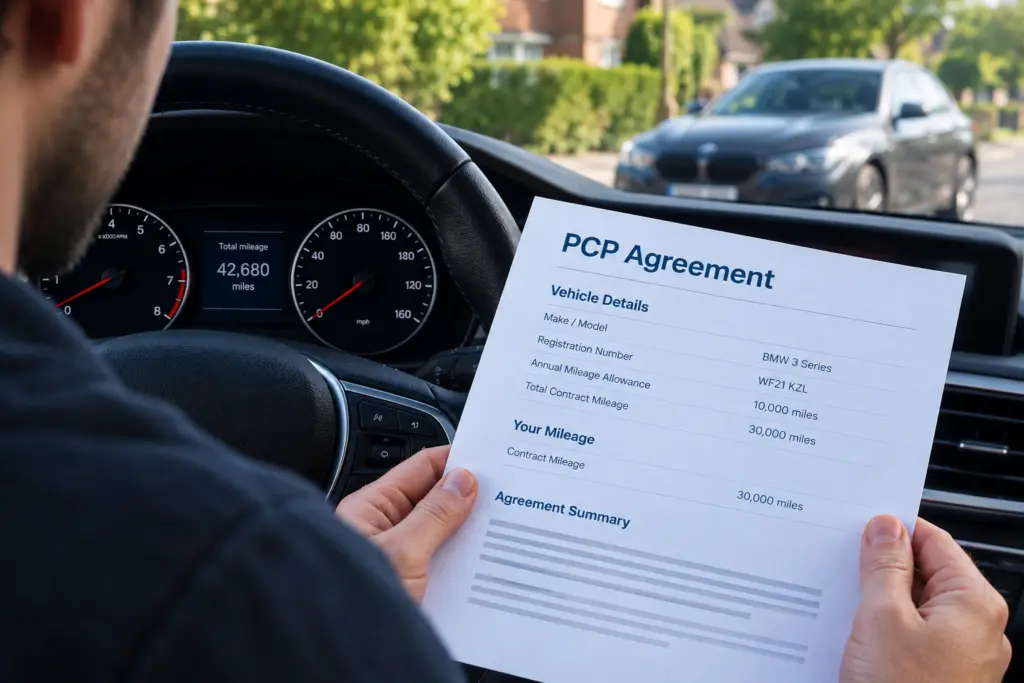
A PCP agreement normally includes an annual mileage allowance and a total mileage limit for the full contract. For example, if your total contract mileage is 30,000 miles for a three-year period, then the annual mileage allowance will be 10,000 miles.
Mileage matters because a vehicle generally loses value as it is driven. Higher mileage means greater depreciation, which affects the vehicle’s expected value at the end of the agreement. If you exceed the agreed mileage and return the vehicle, the finance provider may charge an excess mileage fee based on your agreement.
Check How Much Over Your PCP Mileage Allowance You Are
Before deciding what to do, establish exactly where you stand.
- Start by checking the vehicle’s current odometer reading. Comparing it with previous mileage records through a vehicle mileage history check can help identify the recorded mileage timeline.
- Compare it with the mileage allowance stated in your PCP agreement
- Consider how much time remains and how many miles you are likely to drive during the rest of the contract
For example, if your agreement allows 30,000 miles and your vehicle has already covered 28,000 miles halfway through the contract, you may need to review your expected future driving. You could potentially cover considerably more than the original allowance by the time the agreement ends.
Keep in mind that your annual mileage allowance isn’t necessarily a limit you have to meet evenly each year. What matters is the mileage terms set out in your specific PCP agreement and how excess mileage is treated at the end of the contract.
Contact Your Finance Provider Before the Agreement Ends
If your driving habits have changed, contacting the finance provider is one of the most practical steps you can take. The best thing is to do it as soon as you realise, not in the final weeks of the agreement.
Don’t wait until you’re handing the vehicle back if you already know your mileage will be higher than agreed. Get in touch, explain your changing driving habits and situation, and ask what options are available under your PCP agreement.
The conversation might cover:
- Increasing your mileage allowance
- Whether the contract terms can be revised
- How a mileage adjustment could affect your payments
- The excess mileage rate in your agreement
- Your options when the PCP reaches its end
Availability and terms depend on the finance provider and your individual agreement, so it’s better to get the relevant figures and conditions directly from the lender.
Can You Increase Your PCP Mileage Allowance?
Sometimes, yes, though it depends on the lender, the timing, and the terms of your specific contract.
If a provider does allow it, expect the finance calculation to shift too. A higher mileage allowance usually means a lower expected future value for the car, which can affect your monthly payment or other contract terms. That’s a normal part of how the adjustment works, not a penalty for asking.
If you know early in the agreement that your expected mileage has increased, requesting a change sooner gives the provider more time to review available options and factor any changes into the remaining term. Not every provider offers this option, so check with the finance provider as soon as possible to understand the available options.
Consider Paying the Excess Mileage Charge
If you return the vehicle at the end of your agreement and have exceeded the agreed mileage, excess mileage charges on a PCP agreement may apply. The amount is normally based on the number of additional miles and the excess mileage rate specified in your finance agreement.
The basic calculation is:
Additional miles × agreed excess mileage rate = excess mileage charge
For example, if you exceed your allowance by 4,000 miles and your agreement specifies an excess mileage rate of £0.10 per mile:
4,000 × £0.10 = £400
The actual rate varies between finance agreements, so check your own contract rather than relying on an example or a rate from another provider. Knowing the potential cost before the agreement ends makes it easier to compare your options.
Explore Your End-of-Contract Options
If you are approaching the end of your PCP agreement, consider these options. Available options depend on your circumstances, the vehicle’s condition and value, and the terms of your finance agreement.
Return the Vehicle
You can normally return the vehicle at the end of the PCP agreement, subject to the contract’s conditions. The finance provider or inspection company will assess the vehicle’s condition and mileage. If the mileage is above the agreed allowance, an excess mileage charge may apply.
You should therefore check the mileage terms and the vehicle’s expected mileage before arranging the return.
Purchase the Vehicle
Another option is to purchase the vehicle by paying the optional final payment, sometimes called the balloon payment, along with any other amount required under the agreement.
When you buy the vehicle, the ownership arrangements change because you are no longer returning it to the finance provider under the PCP agreement. Excess mileage charges are typically waived because they generally relate to returning the vehicle. However, check your specific contract and confirm the figures with your finance provider.
If you are considering keeping the car, ask the provider for the exact amount needed to complete the purchase.
Part-Exchange or Start a New Agreement
Some drivers choose to move into another vehicle when their PCP agreement ends. This could involve part-exchanging the current vehicle and entering into a new finance agreement, subject to the arrangements offered by the dealer and finance provider.
Do not assume that moving into another agreement automatically removes the financial impact of excess mileage. Ask for a clear breakdown of how your existing agreement will be settled and how the next agreement would work.
What Should You Do If You Know You Will Exceed Mileage?
Available options can depend on how much time is left on your PCP agreement.
If You Have Many Months Remaining
Start by estimating your likely total mileage at the end of the agreement. Then contact the finance provider and ask whether you can change your mileage allowance. Acting earlier gives you more time to understand any revised terms and their potential effect on your payments.
If You Are Close to the End of the Contract
Work out approximately how many miles you are likely to be over your allowance. Check the excess mileage rate in your agreement and calculate the potential charge. Then compare that figure with your other end-of-contract options, including returning the vehicle, purchasing it, or discussing a replacement vehicle.
If Your Circumstances Have Changed
Mileage can increase for many ordinary reasons. A new job, longer commute, relocation, or changes in family circumstances can all lead to more driving than expected. If your circumstances have changed, tell your finance provider rather than assuming the original mileage estimate still applies.
What Should You Avoid When Managing PCP Excess Mileage?
Managing excess mileage starts with understanding the agreement rather than making assumptions about how PCP contracts work. A few habits tend to make the situation worse rather than better:
- Ignoring the mileage difference until vehicle handback
- Assuming every PCP provider uses the same mileage terms
- Looking only at the monthly payment when choosing an allowance
- Assuming an excess mileage rate from another finance agreement applies to yours
- Waiting until the final days of the contract to investigate your options
Your PCP agreement contains the specific terms that apply to your vehicle, including the agreed mileage and any applicable excess mileage rate.
How to Avoid Excess Mileage Problems on Future PCP Agreements
The easiest way to manage excess mileage is to estimate your driving realistically before entering a PCP agreement. Start with your normal weekly or monthly mileage, then consider journeys that may not happen every week. Include commuting, weekends away, holidays, visiting family, and other regular personal trips.
Also consider whether your circumstances could change during the agreement. A job move or relocation could significantly increase your annual mileage.
Before signing a PCP agreement, make sure you understand:
- Your annual and total mileage allowance
- The excess mileage rate
- How mileage is treated at the end of the agreement
- The available end-of-contract options
- Whether the provider has any process for changing your mileage allowance
Choosing a lower mileage allowance may reduce the quoted monthly payment, but it can create additional costs if you drive substantially more. A realistic mileage estimate can help you make a more informed choice from the start.
The Bottom Line
Exceeding a PCP mileage allowance does not mean there are no options available. Whether that means adjusting your agreement, budgeting for the charge, or planning your end-of-contract route, your options depend on your specific agreement and how early you act. The one thing that consistently narrows your choices is waiting until handback to deal with it.



Not sure which module fits your vehicle?
Use our vehicle finder or talk to our UK support team.