Are Mileage Blockers Illegal in the UK?
No, UK law makes it illegal to own a mileage blocker. The legal position depends on how a mileage blocker...
No, UK law makes it illegal to own a mileage blocker. The legal position depends on how a mileage blocker is possessed, supplied, or used. No single offence in the UK makes every mileage blocker unlawful in all circumstances. The mileage blocker can become a legal risk if it is linked with fraud, misleading mileage information, or a plan to deceive another party to obtain a financial benefit.
In vehicle sales and other consumer deals, inaccurate mileage matters because it can sway a consumer’s choice. The Digital Markets, Competition and Consumers Act 2024 and the Fraud Act 2006 can therefore become relevant depending on the circumstances.
What Does UK Law Say About Mileage Blockers?
No single UK law simply states that “mileage blockers are illegal”. How the mileage blocking device works is pretty simple and does not raise a red flag if used in a controlled environment. However, different areas of law can become relevant depending on what a person does with the vehicle, the device, and its mileage information.
Two important pieces of legislation are the Digital Markets, Competition and Consumers Act 2024 and the Fraud Act 2006. The DMCC Act is particularly relevant to unfair commercial practices involving traders and consumers, while the Fraud Act contains several offences relating to fraud, including false representation and articles intended for use in fraud.
Legal vs Illegal: What Actually Matters
UK law does not classify a mileage device as lawful or unlawful based on the physical hardware alone. The legal position depends on the circumstances in which the device is possessed, supplied or used, and how the vehicle’s mileage is represented to other parties.
The Office of Fair Trading carried out a compliance review of businesses offering mileage correction services between November 2012 and March 2013.
The review found that adjusting a vehicle’s odometer to show an inaccurate mileage could potentially be a criminal offence under the consumer-protection legislation applicable at the time and the Fraud Act 2006. The review is useful historical context, but current consumer-protection requirements should be assessed under the legislation that applies today.
The Digital Markets, Competition and Consumers Act 2024 replaced and updated the previous Consumer Protection from Unfair Trading Regulations for commercial practices from 6 April 2025. The CMA’s current guidance continues to address misleading actions, misleading omissions and professional diligence in trader-to-consumer transactions.
The key distinction is between legitimate technical use and conduct involving inaccurate mileage, deception, fraud, or misleading commercial practices.
The existence of a mileage device does not by itself establish that an offence has been committed, while possession, supply or use can become legally significant when the requirements of the relevant law are satisfied.
Digital Markets, Competition and Consumers Act 2024
The Digital Markets, Competition and Consumers Act 2024 provides the current statutory framework for unfair commercial practices involving consumers. The relevant consumer-protection provisions came into force on 6 April 2025.
The Act prohibits unfair commercial practices and includes rules covering misleading actions and misleading omissions. A misleading action can involve false or misleading information about a product or another matter relevant to a consumer’s transactional decision. A misleading omission can involve withholding material information that the average consumer needs to make an informed decision.
Vehicle mileage can be material information when a used vehicle is offered for sale. The Competition and Markets Authority gives a specific example involving a second-hand car that has been “clocked” from 95,000 miles to 25,000 miles.
The CMA explains that the false mileage can mislead consumers, that the genuine mileage can be material information, and that the conduct can also fall short of the required standard of professional diligence.
The CMA also states that the trader does not need to complete the vehicle sale for the relevant unfair practice rules to be breached. The specific legal outcome always depends on the circumstances and the statutory requirements.
The DMCC consumer-protection provisions discussed here concern commercial practices by traders involving consumers. A private sale is not automatically treated in the same way as a trader-to-consumer transaction, although other legal rules can still apply depending on the circumstances.
Fraud Act 2006
The Fraud Act 2006 can apply where mileage is dishonestly misrepresented and also contains separate offences involving articles intended for use in fraud.
- Section 2 covers fraud by false representation. Broadly, this involves dishonestly making a false representation with the required intention concerning gain, loss, or the risk of loss. A person does not commit this offence simply because they possess equipment capable of affecting a vehicle’s mileage.
- Section 6 is also important. It makes it an offence to have an article in one’s possession or control for use in the course of or in connection with fraud, where the statutory requirements are met.
- Section 7 separately deals with making, adapting, supplying or offering to supply an article where the person knows that it is designed or adapted for use in fraud, or intends it to be used to commit or assist in committing fraud.
This means the legal position cannot simply be determined by whether a vehicle sale has taken place. The circumstances surrounding the device, the purpose for which it is used and the specific statutory requirements all need to be considered.
The Fraud Act 2006 applies to England, Wales and Northern Ireland. Scotland operates under a separate criminal-law framework, so the Fraud Act should not be treated as a complete statement of the law in Scotland.
What Role Do DVLA and MOT Records Play?
The DVLA holds vehicle registration and licensing information, but its public vehicle enquiry service does not provide a vehicle’s historical odometer readings. It allows users to check information such as the vehicle’s tax and SORN status, MOT expiry, first registration date, V5C issue date, year of manufacture, engine size, fuel type, emissions, and export status.
For historical mileage information, the official GOV.UK MOT history service is more relevant. It shows the mileage recorded at previous MOT tests, along with other test results. For cars, motorcycles and vans, the service provides MOT results from tests carried out since 2005.
MOT mileage records can help identify inconsistencies in a vehicle’s recorded history, but treat them as historical records rather than automatic proof that the current odometer reading is genuine. The official DVSA guidance confirms that the MOT history service includes the mileage recorded at the time of the test.
For that reason, it is useful to distinguish between DVLA vehicle information and MOT mileage records when checking a vehicle’s history.
When Can Using a Mileage Blocker Become Illegal?
Using a mileage blocker can become a legal problem where it is connected with misleading another party or with conduct that satisfies the requirements of a fraud offence. For example:
- Using a device so that a vehicle is presented as having covered fewer miles than its actual recorded history.
- Giving a buyer a mileage figure that is known to be inaccurate.
- Withholding relevant mileage information in circumstances where the applicable law requires or makes its disclosure material.
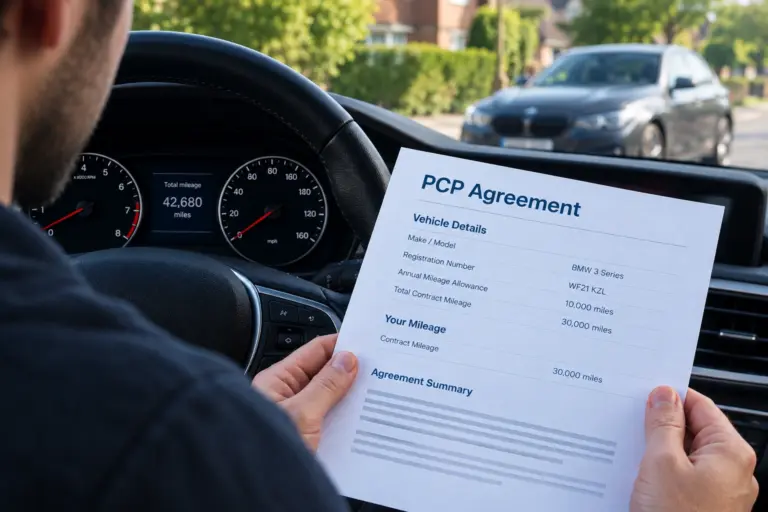
- Using it to keep the vehicle within the agreed PCP mileage limits and avoid the consequences of exceeding mileage limits.
- Using inaccurate mileage information to obtain a financial benefit or a more favourable contractual position.
- Knowingly presenting inaccurate mileage as genuine.
The exact legal consequences depend on the facts, the parties involved, what was represented, and which statutory requirements are satisfied.
The important distinction is that the device itself does not determine the legal outcome. The surrounding conduct, purpose, and representations about the vehicle’s mileage are what need to be assessed.
Is It Illegal to Buy or Own a Mileage Blocker?
Buying or owning a mileage blocker is not automatically fraud. However, possession can become legally significant where the requirements of section 6 of the Fraud Act 2006 are satisfied. It is therefore useful to distinguish between:
- Purchasing the device.
- Possessing or controlling the device.
- Using the device.
- Supplying or offering to supply the device.
- Making representations about the vehicle’s mileage.
The legal position depends on the circumstances and purpose. Section 6 concerns possession of an article for use in fraud, while section 7 addresses making, adapting, supplying or offering to supply an article for use in fraud where the statutory conditions are met.
When Can a Mileage Blocker Be Used Lawfully?
Mileage-related equipment can have legitimate technical applications in controlled environments where its use complies with applicable law, contractual requirements and the purpose for which the vehicle is being assessed. Potential examples include:
- Testing
- Diagnostics
- Vehicle development
- Component testing
- Dyno testing
- Appropriate motorsport applications
- Other controlled or off-road environments where the vehicle is being assessed for a defined technical purpose
Calling an activity “testing” or “off-road use” does not automatically make every subsequent use lawful. The treatment of the vehicle’s mileage information still matters.
For example, if a vehicle has been used in a controlled testing environment and is later sold, the seller must avoid making false or misleading representations about its mileage. A legitimate technical purpose at one stage does not create a blanket exemption from consumer-protection or fraud law.
Is It Illegal to Sell a Car That Has Used a Mileage Blocker?
No blanket rule states that a vehicle previously used with a mileage blocker can never be sold. The legal question is how the vehicle’s mileage and history are represented and whether applicable information is withheld or misrepresented.
For trader-to-consumer sales, the current consumer-protection rules are particularly relevant. The CMA’s guidance specifically identifies a clocked second-hand car as an example of conduct that can involve misleading actions, misleading omissions and a failure to meet professional-diligence requirements.
- Misleading mileage: A false mileage representation can mislead a consumer about the vehicle.
- Material information: Genuine mileage can be information a consumer needs to make an informed decision.
- Professional diligence: The CMA states that clocking a vehicle can fall below the standard expected of a trader in the second-hand car sector.
- False representation: Where the facts satisfy the requirements of the Fraud Act, criminal liability can arise.
Where a vehicle’s recorded mileage does not accurately represent its mileage history, the seller should avoid making false or misleading statements about the mileage and should provide any information that applicable law or the transaction requires.
Comparing the vehicle’s current mileage with its previous mileage records can also help establish whether the reported mileage is consistent.
What Are the Legal Risks of Misusing a Mileage Blocker?
The consequences depend on what happened, who was affected, the parties involved, and which legal requirements apply.
Consumer-Protection Enforcement
Where a trader engages in an unfair commercial practice involving misleading mileage information, the DMCC Act may apply. The Act provides enforcement mechanisms for unfair commercial practices, and authorised enforcement bodies can take action where the statutory conditions are met.
Fraud-Related Consequences
Where the evidence satisfies the requirements of a fraud offence, criminal consequences can follow. Fraud under the Fraud Act 2006 is punishable by imprisonment and/or a fine. The maximum sentence varies according to offence.
For example, a conviction on indictment for fraud under section 1 can lead to up to 10 years’ imprisonment. Section 6 carries a maximum sentence of 5 years’ imprisonment on conviction on indictment, while section 7 carries a maximum of 10 years.
This should not be interpreted as meaning that every mileage-blocker case is a fraud case. The statutory elements of the relevant offence must be established.
Civil Disputes
A buyer or another affected party may also have civil remedies depending on the transaction, the representations made and the applicable law. The available remedy depends on the specific circumstances.
Financial Consequences
Misleading mileage can affect the price paid for a vehicle and can lead to financial disputes between buyers and sellers. It can also create contractual or other financial issues where inaccurate mileage has been provided to a lender, insurer or another party.
The practical point is simple: legal exposure comes from the conduct surrounding the device, not merely from the existence of equipment capable of affecting mileage.
The Bottom Line
A mileage blocker is not subject to a single blanket UK rule that makes every form of possession or use illegal. The legal position depends on the circumstances, including the purpose for which the device is possessed or used and whether its use or supply is connected with fraud or misleading conduct.
For trader-to-consumer vehicle sales, the Digital Markets, Competition and Consumers Act 2024 is particularly relevant. The CMA’s guidance specifically identifies a clocked second-hand car as an example where false mileage can mislead consumers and where genuine mileage can be material information.
The Fraud Act 2006 also becomes relevant where the statutory requirements for fraud or offences involving articles for use in fraud are satisfied. Simply having equipment capable of affecting mileage does not, by itself, establish fraud, but possession or supply can become an offence where the requirements of sections 6 or 7 are met.
Legitimate controlled testing, diagnostics, development and similar applications should therefore be distinguished from deliberately creating inaccurate mileage and presenting it as genuine.
Disclaimer: This article provides general information about UK law and is not legal advice. The legal position can depend on the facts, jurisdiction, transaction and circumstances involved. If you have a specific legal issue, seek advice from a suitably qualified legal professional.



Not sure which module fits your vehicle?
Use our vehicle finder or talk to our UK support team.