Do Rolling Road Runs Count Towards Your Car’s Mileage?
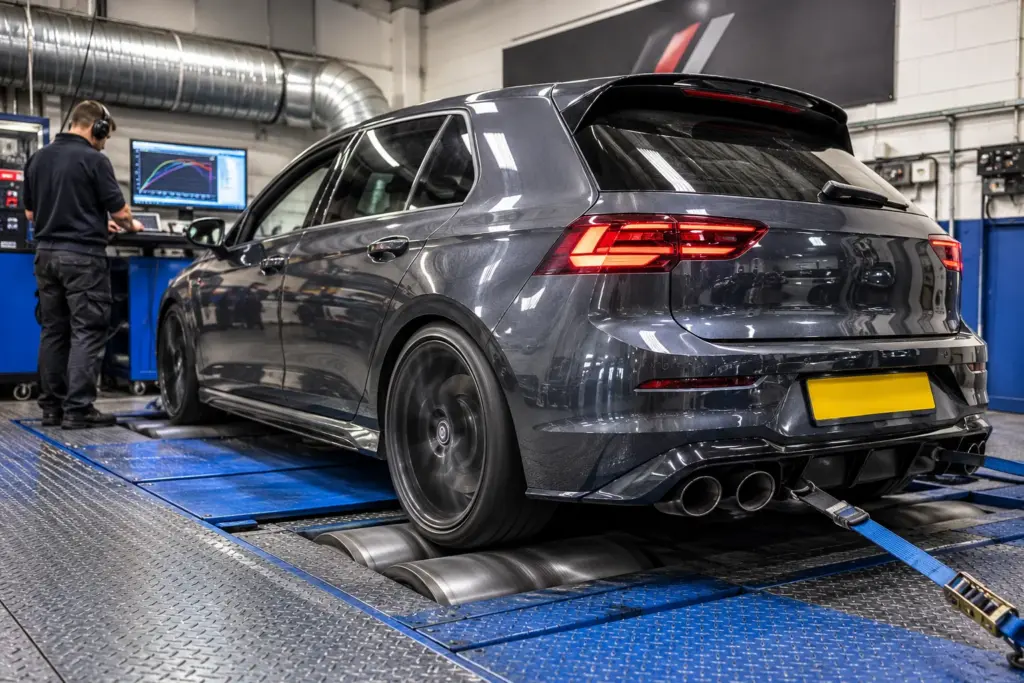
Usually, yes. If the wheels that feed the car’s speed signal are turning on the rollers, the odometer counts that distance just as it would on the road. A few power runs add very little, but longer mapping or test sessions can add tens of miles.
The result depends on how the vehicle measures speed and how the dynamometer is set up. This post covers when the answer changes, how many miles different tests add, and what to record so the extra miles can be explained later.
Why the Odometer Keeps Counting on a Rolling Road
The odometer has no way of knowing the car isn’t going anywhere. It counts the speed signal, not the scenery.
In most modern cars, wheel speed sensors measure how quickly each wheel turns and report to the ABS module. The module processes the signal and supplies vehicle speed information to other systems, including the instrument cluster. Older designs, and cars without ABS, take the signal from the gearbox output speed sensor. The setup varies between manufacturers, but the principle is the same: the car calculates distance from measured speed over time.
GEARS Magazine (December 2025) describes a common layout, using Toyota and Nissan as examples: the instrument panel receives data from the ABS control unit, which processes inputs from the wheel sensors, while the engine and transmission control units compare this data with the transmission speed sensor signal.
On a rolling road, the driven wheels turn at real road speed, so the signal looks like normal driving. As long as the car accepts the speed signal as valid, the displayed mileage increases even though the vehicle stays in the same position.
Many modern cars store mileage in more than one module, not just the instrument cluster. A mismatch between them can show up if one module stops receiving the speed signal or is replaced.
When the Answer Changes
Not every vehicle responds to a rolling road in exactly the same way. The number of wheels turning, the drivetrain configuration, and the vehicle’s electronic systems can all affect the result.
Two-Wheel-Drive Rollers and Which Wheels the Car Listens To
A conventional two-wheel-drive (2WD) rolling road turns only the driven axle. In front-wheel-drive cars, the front wheels rotate while the rear wheels stay still, and the reverse applies to rear-wheel-drive cars. This usually works as expected when the vehicle calculates speed from the driven wheels.
However, some vehicles use data from multiple wheel speed sensors or compare readings across axles.
If the non-driven wheels remain stationary, the car may detect a mismatch. Depending on its design, the speedometer may under-read or show zero, the odometer may count less distance, or warning lights may come on.
The way the ABS calculates vehicle speed and communicates with other control units varies by make and model, so the dyno operator needs to know the vehicle’s drivetrain and electronic configuration before testing.
Four-Wheel-Drive Rollers and Linked Axles
Four-wheel drive (4WD) vehicles need more consideration because their front and rear axles are mechanically or electronically connected.
Running a 4WD car on a single-axle rolling road can create problems. The difference in wheel speeds may confuse the vehicle’s control systems or place unwanted stress on the drivetrain. Some 4WD dynamometers, such as Lohen’s 4WD rolling road, use a belt drive that links both axles. Lohen notes this also lets the non-driven wheels on front-wheel-drive and rear-wheel-drive cars turn at the same speed as the driven wheels.
With all four wheels turning, the car behaves as it would on a normal drive, and the odometer counts distance as it would on the road. Make sure a 4WD vehicle is tested on equipment suited to its drivetrain.
Dyno Mode Switches Off Driver Aids, Not the Odometer
Some vehicles have a dyno mode or roller mode designed to make dynamometer testing easier.
In normal driving conditions, the electronic stability control (ESP) and traction control systems constantly monitor wheel speeds, and when they detect wheelspin or an unexpected difference in wheel speeds, they step in automatically by cutting power or braking individual wheels. Dyno mode may let you disable or modify some driver-assistance features.
For example, InsideEVs’ report on Tesla Dyno Mode describes a feature designed to disable traction control, stability control, and automatic emergency braking for dynamometer testing.
Roller mode helps the vehicle behave correctly on the equipment. It does not necessarily change how the odometer records distance.
Trip Meter and Main Odometer Can Disagree
A rolling road session can sometimes produce an unusual trip meter reading without a matching change in the main odometer.
One owner’s experience shows how odd this can look. On the MBWorld forum, the owner of a Mercedes E55 AMG reported that the trip computer mileage jumped by about 200 miles over three dyno pulls, and in the same post said the regular odometer didn’t change.
That is a single report, not evidence that every Mercedes or every rolling road behaves this way.
Trip computers and odometers can calculate their figures differently, so a strange trip reading after a session isn’t proof that the main odometer has been altered or that the car has covered the displayed distance. If the figures do not make sense, compare the readings before and after the session and ask the workshop to explain what the vehicle displayed.
How Many Miles Does a Rolling Road Session Add?
A typical power-run session adds a few miles at most. Development and emissions testing add far more. The figures below are worked illustrations, so treat them as ballpark numbers.
- One power run: Roughly 15 seconds at an average speed of about 75 mph adds about 0.3 miles. The actual figure depends on time spent accelerating and decelerating.
- A power-run session: A session with up to three power runs may add a few miles once warm-up, repeat runs, and cool-down are included.
- ECU (engine control unit) mapping session: Longer sessions involve more than full-throttle power runs. The operator may hold the engine at different speeds and loads while adjusting the calibration and checking data. If the roller accumulates an hour of running at an average of 30 mph, that alone represents 30 miles. The actual distance depends on how much time the wheels spend turning and at what speeds.
- An emissions test cycle: The Worldwide Harmonised Light Vehicles Test Procedure (WLTP) includes a laboratory driving cycle. The Class 3 WLTP cycle runs for 30 minutes and covers 23.25 km, which is about 14.4 miles.
The only reliable way to establish how much mileage a particular car has accumulated during a session is to compare its readings before and afterwards. Dyno speed, roller running time, and the vehicle’s own distance-recording behaviour all influence the results.
Are Dyno Miles “Real” Miles?
Yes, in terms of work performed by the engine, gearbox, and drivetrain. The vehicle is running under load, and its mechanical components are doing real work even though the car isn’t travelling along a road. A power run can put considerable load through the engine and transmission. Temperatures can rise significantly, particularly during repeated pulls or sustained testing.
However, dyno mileage is not identical to road mileage in every respect. Brakes, steering, suspension, bodywork, and underbody see little or no wear. Tyres wear differently too, because they can flex more and run hotter on rollers than on tarmac.
For servicing, warranty records, and resale, the vehicle’s mileage remains the recorded figure. Miles added on a rolling road stay on the record even though the car never left the workshop. That is why keeping a workshop record matters. A documented dyno session helps explain why a vehicle’s recorded mileage increased without a corresponding journey on public roads.
Why Warning Lights Can Come On During a Rolling Road Run
Warning lights can appear because the vehicle’s ABS and stability systems detect wheel-speed differences they wouldn’t normally expect during driving.
Depending on the vehicle, the stability and ABS systems may read some wheels turning while others stay still as a fault or a skid.
Typical signs include:
- ESP or traction control light: The stability system detects unusual wheel-speed differences or unexpected wheelspin.
- ABS warning: The system identifies inconsistent information from one or more wheel speed sensors.
- Limp mode: The engine or transmission control systems may limit performance after detecting a fault or implausible signal.
- Transmission wind-up: Some 4WD systems may report drivetrain problems if the front and rear axles are turning at incompatible speeds.
The DVSA’s testing advice for MOT testers is a useful parallel. For certain four-wheel-drive models, it says the service brake must be tested with a decelerometer rather than on rollers, which shows why 4WD cars need the right equipment.
When booking, tell the operator whether the car is front-wheel drive, rear-wheel drive, or 4WD. Ask whether the equipment suits that configuration and whether the manufacturer provides a dyno or roller mode. Some warnings may clear after you return the vehicle to normal operation and restart it. Others may require a diagnostic scan and investigation.
What Owners and Workshops Should Note Down
Record the odometer reading before and after every session. A photograph of each reading, supported by a workshop job card, provides a straightforward record of the distance added.
Vehicle owners should keep the job sheet or dyno report with the service history so the extra miles can be explained later.
Workshops record a little more detail:
- Starting and finishing mileage: Record the dashboard reading before and after testing.
- Session details: Note whether the work involved power runs, ECU mapping, diagnostics, or development testing.
- Equipment used: Identify whether the vehicle was tested on a 2WD or linked 4WD rolling road, or a hub dynamometer.
- Vehicle configuration: Record the drivetrain type and whether dyno or roller mode was used.
- Dyno-logged distance: Where the dyno software records it, note the distance the rollers measured.
For development and test vehicles, some workshops fit a mileage blocker to pause odometer recording during dyno runs. In that case, log the distance run on the rollers and the work dates. According to the RAC, UK law requires any known mileage discrepancy to be disclosed when the car is sold or presented for an MOT or service.
These records help diagnose mileage discrepancies and let buyers make an informed decision.
Book the Session, Log the Miles
The odometer usually counts dyno distance, and even a short session adds mileage whenever the speed signal is active. Photograph the readings before and after, and keep the job sheet with the service history so the extra miles are easy to explain later.
If you or the workshop has questions about vehicle electronics during dyno testing or development work, contact Smelecom technical support for assistance.



Not sure which module fits your vehicle?
Use our vehicle finder or talk to our UK support team.