How Much PCP Mileage Should You Declare?
You can choose the right PCP mileage allowance only when you have an honest estimate of how much you are...

You can choose the right PCP mileage allowance only when you have an honest estimate of how much you are likely to drive during the agreement. Choosing a very low figure may make the deal look cheaper each month, but it can leave you with excess mileage charges if you drive more than agreed. A higher allowance can increase the monthly payment because the vehicle is expected to have a lower value at the end of the agreement.
The best approach is to look at how you actually use your car, include journeys you make only occasionally, and then check the mileage terms before signing the finance agreement.
What Is a PCP Mileage Allowance?
A PCP mileage allowance is the number of miles you agree to drive during your Personal Contract Purchase agreement.
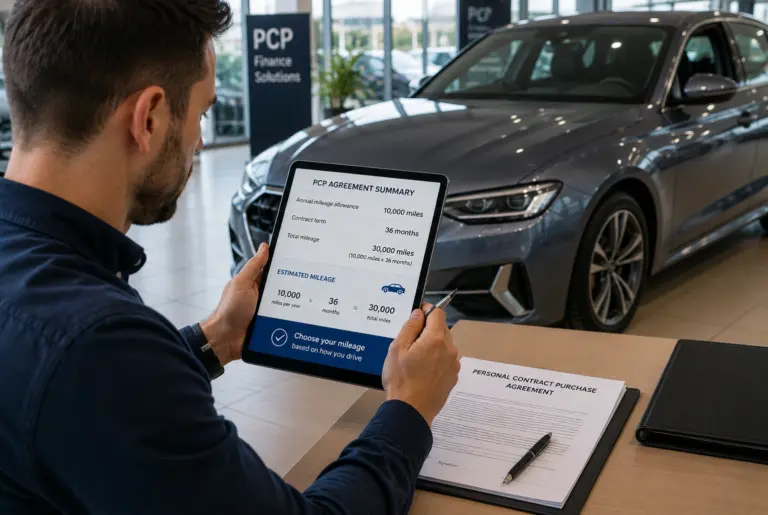
It is usually discussed as an annual mileage allowance, although your finance agreement may also state the expected mileage over the full contract term. For example, a three-year PCP with an allowance of 10,000 miles per year would normally equate to 30,000 miles over the agreement.
The allowance matters because anticipated mileage is one of the factors used when determining the vehicle’s Guaranteed Minimum Future Value (GMFV). The FCA describes anticipated annual mileage as a factor used, in part, to determine the GMFV for a PCP agreement.
It also matters to you because your agreement may include a charge if you return the vehicle after exceeding the agreed mileage. Before signing, check:
- Your annual mileage allowance
- The total mileage for the agreement, if stated
- The excess mileage rate
- The contract length
- What happens if your expected mileage changes
How Do You Work Out Your Annual Mileage?
The easiest way to choose a realistic allowance is to start with the miles you already drive and then account for journeys that do not happen every week. Think about your normal year rather than just your current weekly commute. This should include:
- Commuting: How far do you travel to and from work?
- Family journeys: Do you regularly drive children or relatives?
- Shopping and local trips: How often do you use the car for everyday errands?
- Weekend driving: Include regular trips that add mileage outside your working week.
- Holidays: Think about longer road trips and annual holidays.
- Visiting friends and family: Occasional long-distance journeys can add up.
- Lifestyle changes: Consider whether your job, home or family circumstances could change during the agreement.
A simple estimate could look like this:
Regular weekly mileage × number of driving weeks + estimated additional journeys = approximate annual mileage
For example, if your regular driving averages around 180 miles a week, that is roughly 9,360 miles over 52 weeks. If you also expect to cover another 1,500 miles on holidays and longer journeys, an allowance around 11,000 miles per year may be more realistic than simply choosing 10,000.
The calculation is only an estimate. The important thing is to build it around your actual driving rather than choosing a mileage figure because it happens to be the cheapest option.
What Mileage Should You Declare for a PCP?
There is no single mileage allowance that is right for everyone. MoneyHelper says 10,000 miles is a usual starting point, but also explains that the allowance can be negotiated and that a higher allowance can mean higher monthly payments.
If you rarely drive and mainly use the car locally, a lower allowance may be appropriate. If you have a long commute, regularly travel between cities or take several long road trips each year, you may need considerably more.
The key is to declare the mileage you realistically expect to drive, not the lowest figure you think you can get away with.
Don’t Base It Only on Your Current Commute
Your commute is only one part of your annual mileage. A common mistake is to calculate the distance to work, multiply it by the number of working days, and use that figure as the PCP allowance. That can leave out hundreds or thousands of miles from:
- Holidays
- Weekend trips
- Family visits
- Shopping
- School runs
- Medical or other regular appointments
- Changes in employment
- Moving house
If you expect your circumstances to change during the PCP term, include that when estimating your mileage.
What Happens If You Choose a Mileage Allowance That Is Too Low?
Choosing a low mileage allowance can reduce the expected mileage used in the finance calculation, but it can create a problem if you later drive significantly more than agreed.
If you return the vehicle above the agreed allowance, your PCP agreement may provide for an excess mileage charge. The rate and terms are set by the finance provider and should be stated in your agreement.
For example, if you agree to 30,000 miles but return the car with 34,000, you have covered 4,000 miles above the agreed allowance. The applicable excess mileage rate would then determine the charge under your contract.
The important point is that choosing a lower allowance is not automatically the better deal simply because the monthly payment may be lower.
Can You Change Your PCP Mileage Allowance Later?
Sometimes, but you should not assume that you can.
Whether you can change your agreed mileage during a PCP depends on the finance provider and the terms of your particular agreement.
If you realise that your driving has increased, contact the finance provider as early as possible and ask whether the allowance can be changed. If an adjustment is available, they can explain how it would affect your agreement and payments.
Do not wait until the vehicle is due to be returned before asking. Your provider can tell you what options are actually available under your contract.
Does Your Mileage Allowance Affect Your PCP Payments?
Yes, mileage can form part of the finance calculation.
The finance provider estimates what the vehicle is likely to be worth at the end of the agreement. Anticipated mileage is one of the factors used in determining the Guaranteed Minimum Future Value.
Because a car with higher expected mileage will generally be worth less at the end of the agreement, a higher mileage allowance can result in higher monthly payments. MoneyHelper specifically notes this relationship when explaining how PCP mileage allowances work.
However, mileage is not the only factor that determines your PCP payment. The vehicle price, deposit, contract length, interest and other terms also affect the overall cost.
So it is better to compare the complete finance agreement rather than choosing a mileage allowance based solely on the monthly payment.
What Should You Check Before Signing a PCP Agreement?
Before agreeing to a PCP, make sure you understand the mileage terms as well as the headline monthly payment. So, check:
- Annual mileage allowance — How many miles are you agreeing to drive each year?
- Total contract mileage — Is a total mileage figure also shown?
- Excess mileage rate — What will you be charged if you exceed the agreed mileage?
- Contract length — How many years will you have the car?
- Monthly payment — How does your chosen mileage allowance affect the quoted payment?
- GMFV or final payment — What is the optional final payment if you decide to buy the vehicle?
- Return conditions — What are the rules around mileage, damage and fair wear and tear?
- Changes to mileage — Can the provider change the allowance if your circumstances change?
MoneyHelper recommends checking the mileage limit, what happens if you exceed it, the contract length, payments, final balloon payment and other terms before agreeing to a PCP.
If any part of the agreement is unclear, ask the dealer or finance provider to explain it before you sign.
A Simple PCP Mileage Allowance Example
Imagine you are taking a four-year PCP and expect to drive:
- 8,000 miles a year commuting and locally
- 1,000 miles a year visiting family
- 1,500 miles a year on holidays and longer trips
Your estimated annual mileage would be:
8,000 + 1,000 + 1,500 = 10,500 miles per year
Over four years, that would be approximately:
10,500 × 4 = 42,000 miles
That does not mean you must choose exactly 10,500 miles or 42,000 miles. It simply gives you a realistic starting point for discussing the allowance with the finance provider.
Your actual agreement is the final reference for the mileage allowance and associated terms.
PCP Mileage Allowance: Final Checklist
Before agreeing to your PCP mileage allowance:
- Look at your actual driving history.
- Calculate your regular annual mileage.
- Add holidays and occasional long-distance journeys.
- Consider possible changes to your job, home or family circumstances.
- Check whether the agreement states annual and total mileage.
- Read the excess mileage rate carefully.
- Compare the effect of different mileage allowances on the complete finance agreement.
- Ask the finance provider if anything is unclear.
There is no benefit in choosing an allowance that looks attractive on paper but does not reflect how you actually use the car.
Choose a Mileage Allowance That Matches Your Real Driving
The right PCP mileage allowance is the one that gives the finance provider a realistic picture of how much you expect to drive.
Start with your normal journeys, add the trips you make less frequently, and think about how your circumstances could change during the agreement. Then compare the resulting estimate with the mileage options offered by the finance provider.
A lower allowance may reduce the quoted monthly payment, but it can leave you exposed to excess mileage charges if you significantly exceed it. A higher allowance can cost more each month, but may be more appropriate if you know you will drive further.
The important thing is to understand the trade-off before signing the agreement, rather than discovering the consequences when the PCP comes to an end.
For more information, see the MoneyHelper guide to buying a car with PCP, which covers mileage allowances, PCP payments and end-of-contract options.



Not sure which module fits your vehicle?
Use our vehicle finder or talk to our UK support team.