PCP Mileage Limits: What Drivers Should Know Before Signing
A PCP mileage limit is the number of miles you agree to drive during your finance agreement. It is an...
A PCP mileage limit is the number of miles you agree to drive during your finance agreement. It is an important part of the deal because the expected mileage can affect the vehicle’s estimated future value and the cost of the PCP.
The right mileage limit is not necessarily the lowest one available. It should reflect how much you realistically expect to drive during the agreement. Choosing an allowance that is too low may leave you facing excess mileage charges if your actual mileage goes beyond the agreed limit.
Before signing, check the mileage allowance, excess mileage rate and other terms in the written finance agreement.
What Does a PCP Mileage Limit Mean?
When you take out a Personal Contract Purchase (PCP) agreement, you will normally agree an annual mileage allowance with the finance provider. MoneyHelper says 10,000 miles a year is a common figure, but this is not a fixed industry standard. Your allowance should reflect your expected use of the vehicle.
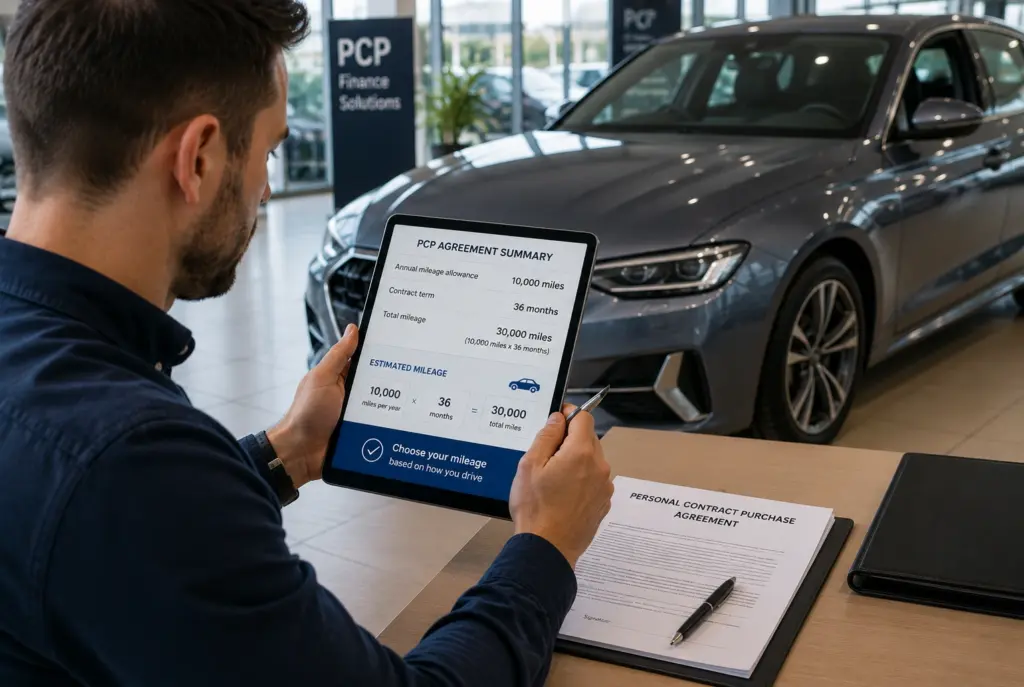
For example, a PCP agreement might allow 10,000 miles per year over three years. That would represent 30,000 miles across the full term if the agreement is structured on that basis.
The expected mileage is important because it forms part of the finance provider’s assessment of the vehicle’s future value. The FCA’s reporting framework specifically identifies anticipated annual mileage as a factor used, in part, to determine the vehicle’s Guaranteed Minimum Future Value (GMFV).
Your finance agreement is the final reference for how your mileage allowance is defined and what happens if you exceed it.
Why Does Mileage Affect Your PCP Payment?
Mileage is one of the factors that can affect the vehicle’s expected value at the end of a PCP agreement.
A car expected to cover more miles will generally be worth less at the end of the agreement than an otherwise similar car expected to cover fewer miles. This can affect the GMFV and, in turn, the way the PCP payments are structured. MoneyHelper confirms that a higher mileage allowance can mean higher monthly payments because the vehicle is expected to be worth less at the end of the agreement.
The basic relationship is:
Higher expected mileage → lower expected future value → potentially higher monthly payments
The reverse can also apply:
Lower expected mileage → higher expected future value → potentially lower monthly payments
However, mileage is only one part of a PCP calculation. The vehicle price, deposit, interest, contract length and other terms also affect the overall cost.
So don’t judge a PCP deal simply by looking at which mileage option gives you the lowest monthly payment.
How Much Annual Mileage Should You Choose?
Start with how much you actually drive in a typical year.
If you already have a car, looking at your recent mileage can give you a useful starting point. Then think about whether your driving will change once you have the new vehicle. Include journeys such as:
- Commuting to and from work
- School runs and regular family trips
- Shopping and everyday errands
- Weekend journeys
- Visits to friends and relatives
- Business travel, where applicable
- Holidays and longer road trips
MoneyHelper recommends adding regular journeys, longer-distance trips and other day-to-day driving when working out how many miles you are likely to cover each year.
Consider Changes During the PCP Term
Your current mileage is not necessarily a perfect guide to the next three or four years. You might change jobs and have a longer commute, move house, start working from home, have children or other new family commitments, begin travelling more for work, or change how often you use the car.
If you already know that your circumstances are likely to change, include that when choosing the allowance.
The aim is not to predict every mile perfectly. It is to choose a figure that is realistic based on the driving you reasonably expect to do.
Annual Mileage vs Total Mileage
PCP agreements commonly state an annual mileage allowance, but you should also understand what that means across the full contract term. For example:
10,000 miles per year × 3 years = 30,000 miles
However, don’t assume that every finance provider assesses mileage in exactly the same way. The wording of the agreement matters.
Check whether your contract specifies an annual limit, a total mileage figure, or both, and read the section explaining how excess mileage is assessed.
This is particularly important if your actual mileage varies from year to year.
What Should You Check Before Signing a PCP Agreement?
Don’t rely only on the monthly payment shown in an advert or discussed at the dealership. Before signing, check these:
- Annual mileage allowance: What mileage figure is included in the agreement?
- Total mileage: What does the allowance represent over the full contract term?
- Excess mileage rate: What will you pay if you exceed the agreed limit?
- Contract length: How long will you have the vehicle?
- Monthly payments: How does your chosen mileage affect the quoted payment?
- Optional final payment: What is the amount if you decide to buy the car?
- Return conditions: What happens when you hand the vehicle back?
- Mileage changes: Can the allowance be changed after the agreement begins?
- Written terms: Does the contract show the mileage figure you actually agreed to?
MoneyHelper specifically recommends checking the mileage limit, the cost of exceeding it and the other terms of the PCP before agreeing to the finance.
The Financial Ombudsman Service also deals with complaints involving mileage caps and excess mileage charges. Where a consumer says they were not made aware of a mileage cap, it can investigate whether the agreement was mis-sold.
A good example is a Financial Ombudsman case involving a customer who had agreed to 6,000 miles a year but said she had not understood that the agreement contained a mileage cap. The Ombudsman considered the information provided at the time of sale and the customer’s previous mileage before deciding how the excess charge should be handled.
The lesson is simple: make sure you understand the mileage figure before you sign the agreement.
Don’t Choose a Low Mileage Limit Just to Reduce the Payment
A lower mileage allowance can make a PCP quote look cheaper because the vehicle is expected to retain more of its value. But that does not necessarily make it the better deal. Imagine two otherwise similar PCP quotes:
- 6,000 miles per year
- 10,000 miles per year
If you regularly drive around 10,000 miles a year, choosing the 6,000-mile allowance simply to reduce the monthly payment could leave you above the agreed limit later.
A better approach is to compare the complete cost of each option using a mileage figure that reflects your actual driving.
The Financial Ombudsman Service has also considered cases where customers were not aware of mileage limits and where the agreed allowance did not reflect their expected use.
The cheapest monthly payment is not necessarily the cheapest option overall.
Can You Change a PCP Mileage Limit After Signing?
Sometimes, but it depends on the finance provider and your specific agreement.
Some providers may allow you to change the expected mileage during the contract, while others may not. If an adjustment is available, it can affect the financial terms of the agreement.
There is no universal rule that allows every PCP customer to increase their mileage allowance whenever they want.
If you think your mileage is going to increase, contact your finance provider as early as possible and ask:
Can I change my agreed mileage allowance, and what would the revised cost be?
Getting the answer directly from the finance provider is better than assuming you can change the allowance later.
When Is a Higher Mileage Allowance Worth Considering?
A higher mileage allowance may make sense if you know you will drive a significant number of miles each year. This could include drivers who:
- Have a long commute
- Regularly travel for work
- Drive long distances to visit family
- Make frequent motorway journeys
- Take several road trips or holidays
- Expect to move house or change jobs
- Have an unpredictable driving routine
A higher allowance may increase the monthly payment because the vehicle is expected to have a lower value at the end of the agreement. That does not automatically make it a bad choice.
The better comparison is between the cost of choosing a realistic allowance now and the potential cost of choosing an allowance that is too low.
What Happens If You Go Over Your PCP Mileage Limit?
If you return the vehicle with mileage above the agreed allowance, your finance agreement may provide for an excess mileage charge.
The rate should be set out in your contract. Some agreements can also have different rates or thresholds, so don’t assume that every PCP uses the same calculation.
For example, if your agreement allows 30,000 miles and you return the vehicle with 34,000 miles, you have covered 4,000 miles above the agreed figure. The applicable rate in your finance agreement determines the potential excess mileage charge.
You can also read our detailed guide to PCP excess mileage charges for more information about how those charges are calculated.
How to Choose the Right PCP Mileage Limit
Before agreeing to a PCP mileage allowance, work through these steps:
- Check your recent mileage. Use your existing driving history as a starting point.
- Calculate your regular journeys. Include commuting, family trips, shopping and other routine driving.
- Add longer journeys. Think about holidays, road trips and visits to family or friends.
- Consider future changes. A new job, house move or lifestyle change could increase your mileage.
- Compare realistic mileage options. Look at the complete finance cost, not just the monthly payment.
- Check the excess mileage rate. Know what could happen if you exceed the agreed limit.
- Read the agreement. Make sure the written mileage figure matches what you actually agreed to.
- Ask questions before signing. If anything about the mileage terms is unclear, ask the finance provider to explain it.
PCP Mileage Limits: What to Remember Before Signing
Your PCP mileage limit should reflect how you realistically expect to use the car, not simply the mileage figure that produces the lowest monthly payment.
Start with your current driving, add the journeys you expect to make during the agreement and consider any changes that could increase your mileage. Then check how the finance provider’s mileage allowance affects the overall deal.
Most importantly, read the written agreement carefully. Check the mileage allowance, excess mileage rate and rules that apply if your circumstances change.
Taking a few minutes to get the mileage figure right before signing can make the PCP much easier to manage later.



Not sure which module fits your vehicle?
Use our vehicle finder or talk to our UK support team.