How to Check a Vehicle’s MOT History
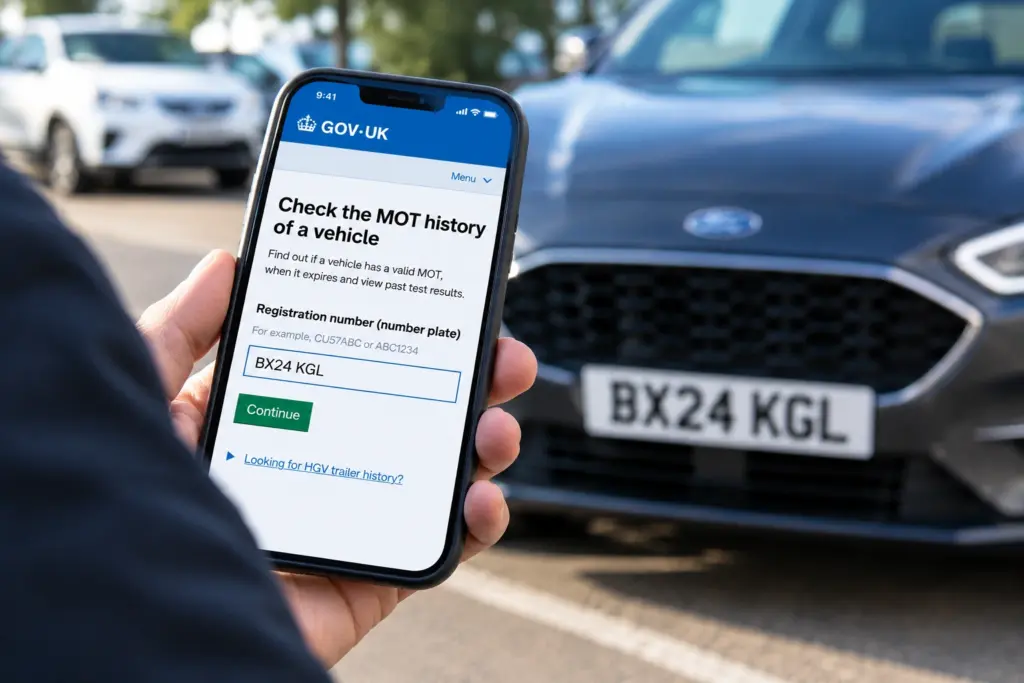
You can check a vehicle’s MOT history for free on GOV.UK, and all you need is the number plate. The record shows every pass and fail, the mileage at each test, the faults and advisories the tester found, and when the next MOT is due. Records go back to 2005 in England, Scotland and Wales, and to 2017 in Northern Ireland.
This guide is for buyers and owners who want to read the results properly, spot recurring problems, understand past failures and make an informed decision.
How to Check MOT History Online in 4 Steps
The official GOV.UK service is the easiest place to start. You don’t need to pay for a report or create an account to check a vehicle’s MOT history.
- Open the GOV.UK MOT history page.
- Type in the number plate.
- Check that the make, model and colour match the car in front of you. If the details still don’t match, walk away.
- Review the test records. Start with the latest result, then work back through the dates, mileage, failures and advisories.
To find out where a test took place in England, Scotland, or Wales, enter the 11-digit reference number from the vehicle’s V5C log book. This lets you see the test location associated with the record.
A lot of people search for a “DVLA MOT check” or “DVLA MOT history”. The DVLA handles registration and vehicle tax. MOT tests and records are managed by the Driver and Vehicle Standards Agency (DVSA) and published on GOV.UK.
Free MOT checker sites show the same data, but many push a paid report after you enter the plate. GOV.UK is the easiest place to start, and it costs nothing.
What Does an MOT History Check Show?
A vehicle’s MOT history provides a record of its previous tests. You will see:
- Test dates and results
- Mileage readings at each test
- Faults and advisories
- MOT expiry date
- Test location (needs the V5C reference)
- Downloadable MOT certificates (England, Scotland and Wales only)
- Outstanding safety recalls, depending on the manufacturer
It doesn’t tell you everything, though. It won’t show service history, outstanding finance, or whether the car has been written off or stolen.
If you are buying a used car, GOV.UK’s used-car buying advice says you should investigate these things before agreeing to a purchase.
How Far Back Does MOT History Go?
Great Britain (England, Scotland, Wales) records start in 2005. Northern Ireland records start in 2017, and you can’t download certificates there.
If you’ve searched a plate and found nothing, don’t panic. New cars don’t need their first MOT until they’re three years old (four in Northern Ireland), so a blank record on a young car is normal.
What Do Dangerous, Major and Minor Defects Mean?
MOT results use different categories to describe a vehicle’s condition. Understanding the difference is important when you are reviewing an older failure.
- Dangerous: Fail. The vehicle is a direct risk to road safety or has a serious impact on the environment. Don’t drive it until it’s repaired.
- Major: Fail. The defect could affect safety, other road users, or the environment, and it needs repairing immediately.
- Minor: Pass. The issue isn’t serious enough to fail the test, but it should be fixed as soon as possible.
- Advisory: Pass. Something to monitor that may need attention soon.
If a car fails on a major defect but its current MOT hasn’t expired, you can usually drive it away for repair. That isn’t the case with a dangerous defect.
A past fail isn’t a red flag on its own. DVSA figures for 2025 to 2026 show that 27.5% of cars and vans failed their MOT at the first attempt. What matters is what happened next, and whether the problem was fixed or came back.
How to Read MOT Results Before You Buy
If you’re checking a used car, the latest MOT result is a good place to start. It gives you the most recent recorded assessment of the vehicle and highlights any problems that may need attention.
Look for the Same Advisory Coming Back Every Year
An advisory appearing once may not be a major concern. If the same issue appears year after year, it could mean that repairs have been delayed.
Pay particular attention to recurring advisories involving:
- Rust or corrosion
- Brakes
- Suspension
- Tyres
Don’t Worry About a Fail Followed by a Pass a Day or Two Later
That’s a normal MOT retest. The garage often fixes the problem, allowing the car to pass. In some cases, a partial retest is carried out after the necessary work.
The important question is whether the same fault returns the following year.
Compare Older Tests with the Latest One
Work backward through the history and look at how the vehicle’s condition has changed. If a suspension problem was noted on a previous MOT and the next test shows no such problem, then it may have been repaired. If the same fault reappears, it is worth asking for more information.
Before you commit, ask the seller three things:
- Why is there a gap in the history?
- Were the advisories repaired?
- Do you have the receipts or other evidence of the work?
A seller with nothing to hide will usually have an answer to all three.
Does a Gap in MOT History Mean Something Is Wrong?
Not necessarily. Gaps in MOT history have plenty of ordinary explanations.
- The car may have been declared off the road
- Kept in storage
- Stripped for a restoration
- Left sitting at a dealer
Whatever the reason, the record shows no mileage for that period. The MOT record alone cannot establish how much the vehicle was used, or its condition, during the missing period.
If you’re buying the car, ask the seller about the gap and for evidence to support the story. It could be a SORN confirmation, storage records, or repair receipts.
A gap isn’t proof of wrongdoing, but it is worth understanding before you decide.
What Can MOT Mileage Readings Tell You?
Every MOT records the mileage, so the number should rise from one test to the next. Three things should make you stop and ask questions:
- Mileage decrease: A later test showing fewer miles than an earlier one.
- Unusually low mileage: A reading that seems inconsistent with the vehicle’s age, condition, or previous use.
- An unexplained jump: A large increase that doesn’t fit the vehicle’s known history.
These are reasons to investigate, not automatic proof of deliberate mileage alteration. Mistakes happen, and the DVSA says it receives over 14,000 requests a year to correct MOT mileage readings. A strange reading is a reason to ask, not a reason to accuse.
It is essential to ask, because one possible concern when investigating unusual mileage readings is whether a mileage blocker has affected the vehicle’s recorded mileage. However, an MOT history alone cannot confirm whether one has been used.
You can check a car’s mileage history through various sources, such as service invoices, repair records, and private vehicle history checks. If you are comparing MOT figures with the dashboard, it’s essential to understand how to read a car’s odometer.
How Do You Fix a Mistake on Your MOT Record?
This one’s for owners. If you spot an error or incorrect mileage in MOT history, you can ask for the record to be corrected.
If the MOT was within 28 days, the garage that did it can check the vehicle and update the record if the information is wrong.
After 28 days, report the mistake to DVSA online. You’ll need evidence showing the correct mileage and a date within one day of the MOT, such as the MOT invoice, a vehicle job card or a service receipt. DVSA will update the record if the information is wrong.
Common mistakes include incorrect mileage, wrong car details or the wrong garage. If a test is missing from the history, or one appears that isn’t yours, email or call DVSA to have it corrected.
When Is Your Next MOT Due and Is the Car Taxed?
The MOT history page shows the MOT due date and the current MOT status.
Tip: You can get the MOT done up to a month (minus a day) early and keep the same renewal date.
For example, if your MOT expires on 20 October, you can have the test carried out from 21 September and retain the 20 October renewal date. You can also sign up for free GOV.UK MOT reminders. Driving without a valid MOT can mean a fine of up to £1,000.
Tax is a separate check. Use the vehicle tax check on GOV.UK to see whether a car is taxed, and do it when you check the MOT. You can’t tax a car once its MOT has run out, so checking tax and MOT together quickly tells you if something is off.
Before You Buy: Your MOT History Checklist
Before agreeing to buy a used car, take a few minutes to review its MOT history.
- The make, model, and colour match the vehicle.
- You have checked the latest MOT result.
- You have looked for recurring advisories.
- You understand any previous MOT failures.
- Any gaps in the history have been explained.
- The mileage readings generally increase over time.
- The service records and paperwork support the MOT history.
- You have checked the vehicle’s tax status and any other relevant history.
An MOT history check is a first step when buying a used car, but it does not give a full picture.
Read the MOT history, check results carefully, ask questions about anything that’s unclear, and compare the information with the car’s paperwork and its physical condition. Spending time on the MOT history and checking records can help you make a better decision before you hand over your money.



Not sure which module fits your vehicle?
Use our vehicle finder or talk to our UK support team.